One pair. One number.
Start at any number from 1–999. Build sequential sets with the same number on each cap and plug.
No more colored zip ties to mark hoses. Give disconnected hoses a matching number, color and name — right on the cap and plug ends.
Explore all tools ↓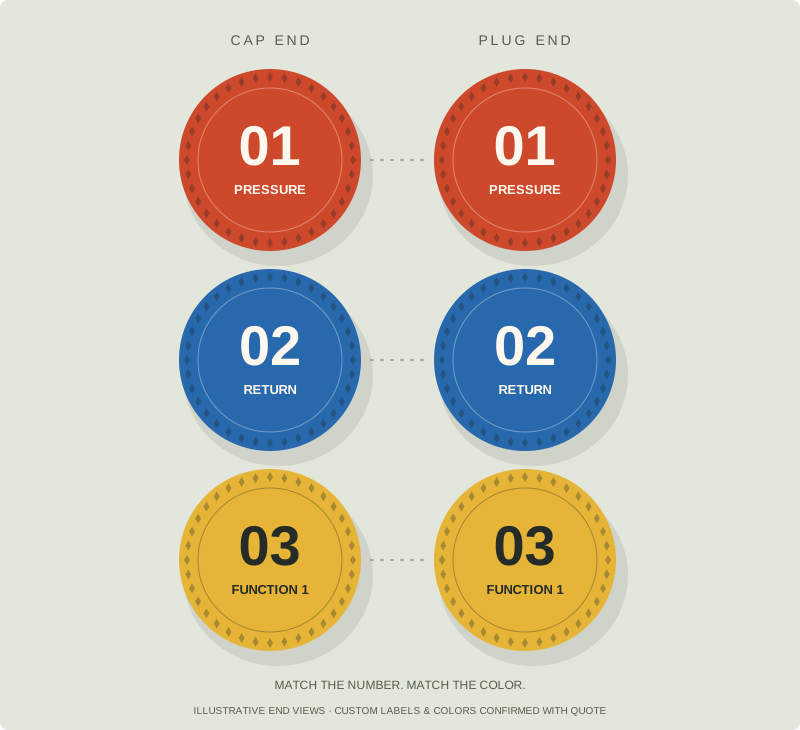
Choose matching identifiers for each disconnected hose and its mating connection. Put the same number on both pieces, choose a color, and add a name that makes sense in your shop.
Start at any number from 1–999. Build sequential sets with the same number on each cap and plug.
Choose a preset or request your own text. Combine a label with a number to suit your hose-identification system.
Request a body color or a mixed-color set. Add your logo to the quote, then email the artwork for a size and legibility check.
Colors are your chosen identifiers, not a universal hose-color code. Verify connections against the equipment documentation before reconnecting. These caps and plugs are dust covers for fully depressurized lines only; a “PRESSURE” label is an identifier, not a pressure rating.
Choose your setup. Add it to your quote.
We’ll confirm pricing and the details with you.
Physical products, not digital print files. Product images are design renders or labeled concept illustrations; colors and final print finish are confirmed with your quote.
A diamond-grip surface gives your fingers something to hold when positioning guides or handling dust caps.
Defined marking edges and opposing reference marks on the slash guide help you lay out the next cut.
Actual outside diameter, fitting size and intended use matter. We’ll confirm the details before you order.
Need another pipe size, a different angle, or a simple shop accessory? Send the dimensions and what you need it to do.
Add tools to your quote and email your request. Pricing, material, color, fit requirements, shipping and payment arrangements are confirmed directly before an order is accepted. This website does not collect payments.
Yes — slash-cut marking guides only. Select your square tubing’s outside width across the flats in inches, or enter a custom width. The same measurement applies to both sides. We confirm corner radius and clearance before production. Angles are measured from the tube axis: 90° gives a square cut. These are single-plane cuts, not compound miters.
Use the measured outside diameter of your pipe, not its nominal size. Select your measured outside diameter in inches, or enter a custom inch measurement. For notching guides, also select the mating pipe diameter. These are outside diameters, not nominal pipe sizes. Fit and design feasibility are confirmed in your quote.
Choose angles from 90° down to 0° in one-degree steps. Notching angles describe the angle between pipe axes. Slash-guide angles describe the cut plane relative to the pipe axis: 90° is square, and 80° is 10° off square. At 0°, a conventional finite sleeve edge cannot be formed; we treat it as a special design inquiry. Very shallow angles also require review. These are marking guides: trace the edge, then remove the guide before cutting.
Choose NPT caps and plugs in nominal sizes from 1/8 inch through 2 inches, as a pair or individual pieces. Plain, numbered, custom-text and logo-request options are available, with your choice of body color. Nominal NPT size is not the measured thread outside diameter. Confirm your fitting is NPT before ordering; other thread standards need a custom inquiry.
No. These printed JIC and NPT caps and plugs are dust covers only, for disconnected, fully depressurized lines. They are not pressure-rated fittings, repair parts or guaranteed fluid seals. Hand-snug only; do not use a wrench.
Yes — request PRESSURE, RETURN, FUNCTION 1 or your own text, with or without matching numbers. You can also request a logo. Attach your artwork manually to the quote email; the website does not upload it. We confirm artwork, available space, color and legibility before production. Labels identify a disconnected line; they do not make a cap pressure-rated.
Choose a preferred color for each matching pair or request a mixed-color set and describe your color-to-number mapping. Each cap and plug in a pair share the same requested color. Color availability, exact shade and marking method are confirmed with your quote.
Select a JIC size from #4 through #16, choose the cap + plug pair, and select numbered ends. Both pieces carry the same number. Choose a starting number and quantity for a sequential set. Individual caps or plugs can also be numbered. Uncommon dash sizes require thread identification before a quote is confirmed.
Send a custom request with your dimensions and intended use. We’ll discuss whether a printed part is suitable and confirm what can be made before you commit.